What is Conceptual Storytelling?

THE TRANSFORMATION
A story of the transformation of a young girl into womanhood. Creating this image helped my conceptual thinking, where I chose the background first, then the figure and the story built from there.
WATCH how I created this image, where I break down the layers and thought process.
What Do I Mean by a Concept?
When I talk about a conceptual approach to composites, I’m not talking about something complicated or intellectual.
I’m talking about starting with an idea — not a background.
A concept is simply:
A feeling
A question
A story
A message
Or even a single line from a song

MR PIGDEN
It all started with the quirky bird character, then I choose the elements, textures. It started out as a fun image. Then when I saw the bird with the scarf and cap, it made me think of a story I had seen about a famous footballer, who hadn’t seen his teacher Mr Pigden in a long time, when he turned and saw him he immediately took off his cap in respect. I drew on a memory that made an impact and that is why I named the character Mr Pigden.

PERCY PANDA AT THE CIRCUS
A fun image it started with the Panda, then the background, I added the support acts to the story of the Panda (bike, cloud balloon, rat) creating a fun image is still about drawing on conceptual thinking.
It gives your image direction. Without a concept, we tend to collect pretty elements and hope they work together.
With a concept, every element has a reason to be there.
Imagination vs Skillset
This is where many creatives get stuck. You can imagine something incredible in your mind. But then you sit down in Photoshop and you can’t quite build it. That gap between what you see in your head and what you can create on screen, that’s not failure.
That’s a skill gap.
Imagination is not the problem - Skillset just needs catching up.
And the only way skill catches up? Practice. Small steps. Repetition.
Not pressure.
Some of the strategies I use are:
I will either start with a background or an element or a digital texture
If using an element (let’s say a quirky character), I will then think what background would go with that element(s)
What/who is the hero and the support acts in your story
Sometimes I add little hidden gems to add a touch of mystery to the art
You don’t always have to have an idea or vision, a story can develop along the way, don’t be frightened to explore and try new things.
Most importantly have fun!
Definition of Conceptual Storytelling
Conceptual storytelling is simply telling a story through an idea rather than a literal scene.
It might explore:
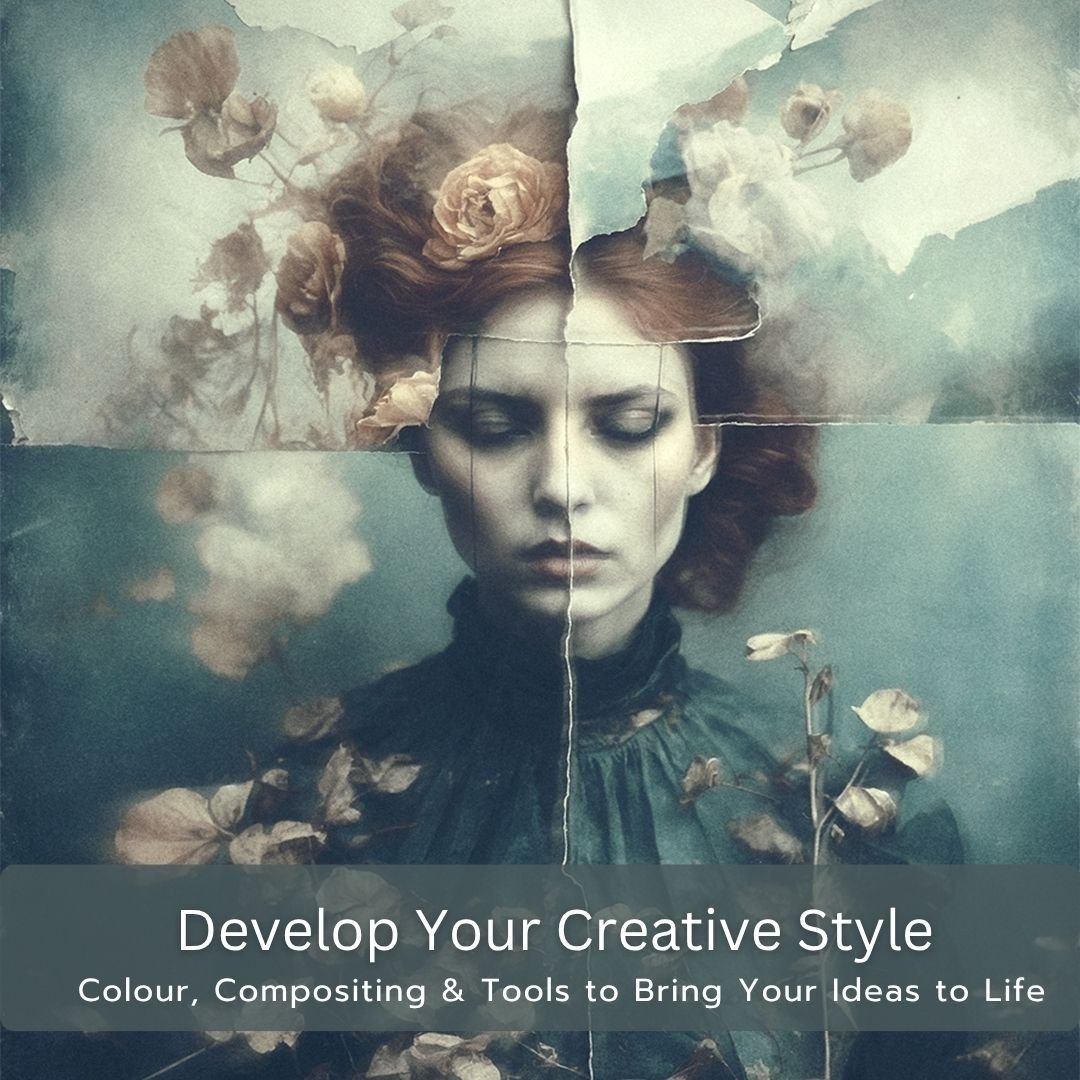
Exploring composite art, colour, and creativity in the age of AI
This ebook is a thoughtful guide for creatives who want to better understand why images work — not just how to edit them. Rather than focusing on software steps or presets, this guide focuses on the thinking behind composite art, colour choices, and creative decision-making.
Inside, you’ll explore:
The foundations of composite art and visual storytelling
How colour influences mood, meaning, and cohesion
Ways to develop stronger creative judgement and confidence
How to approach AI as a creative tool, not a replacement for vision
This ebook is not tied to any specific software and is designed to complement your existing workflow — whether you work in Photoshop, experiment with AI imagery, or combine both.
Ideal for creatives who want to slow down, think more intentionally, and build images with clarity and purpose.
An emotion
A question
A belief
A personal experience
It isn’t about obvious narratives or predictable outcomes. It often leaves space for interpretation. The viewer brings their own meaning to the image — and that’s part of its strength.
In composite work, conceptual storytelling allows you to move beyond “what is happening” and into “what does this mean?” You’re not just building a scene. You’re shaping a message.
Why a Concept Makes Compositing Easier
When you begin with a clear idea, decisions become simpler. Instead of asking:
“What else can I add?”
“What brush should I use?”
“Is this good enough?”
You ask:
Does this support the story?
Does this strengthen the mood?
Does this belong?
A concept becomes your filter.
It helps you:
Choose the right background
Select elements that matter
Simplify instead of overworking
Create mood with intention
A Simple Way to Apply a Conceptual Approach
Here’s a practical way to work.
Start with one sentence.
Example: “A girl learning to trust the dark.”
Or: “Freedom feels fragile.”Choose your hero element.
Who or what carries the message?Choose a background that supports the mood — not just one that looks nice.
Add supporting elements only if they strengthen the idea.
Stop before you over-explain.
Often the strongest images say less.
Concept Comes Before Tools
Whether you use:
Photoshop
Textures
Nik Collection
AI Technology
Or your own photographs
The tool does not create the story. You do.
Technology can extend imagination. It cannot replace it.
If the idea is strong, the tools simply help you shape it.
When Creativity Feels Hard
Sometimes the image in your mind feels out of reach. That’s normal.
Instead of abandoning it, ask:
What part can I build today?
What skill would help me close the gap?
Can I create a simpler version?
Every composite you build strengthens your visual language. Conceptual work isn’t about being clever. It’s about being intentional.
Bringing It Together
A conceptual approach isn’t about making complicated images.
It’s about making meaningful ones.
Start with the idea.
Let the skill grow around it.
And give yourself time to catch up with your imagination.